
Identify Who Owns a Clark County Property
Start with place, not person. The quickest path to a Clark County owner runs from address to parcel to name, then back to the recorded deed. Why bother with the extra steps? An old street number, a duplicated address, or a common name can quietly steer a property search onto the wrong land. Each system displays its own source date, so note it, and carry the parcel number or state key along as the one identifier that stays stable across records.
- Enter the address in Low Tax Info, or locate the parcel through Elevate GIS when the address is incomplete.
- Record the owner label, situs address, state key or parcel number, duplicate number, tax year, and any deed or sale reference actually displayed.
- Search that owner as the grantee in Tapestry, then compare the newest deed's legal description and parcel clues.
- If the grantee is an LLC, verify the entity separately through Indiana INBiz; if it is a trust or estate, preserve the exact recorded name.
Following that order answers the ownership question without mistaking a tax card for a title opinion. Need more on the present holder? The current property owner guide goes deeper. For the chain of earlier holders, continue to previous owners.
Match the Clark County Parcel Before the Person
Clark County systems hand you several identifiers. Address, owner name, parcel number or state key, duplicate number, tax-bill ID. They are not interchangeable. A city planning file, for instance, may rely on an 18-digit Parcel ID instead. Copy whichever identifier you use exactly. Then confirm it against the legal description, the subdivision and lot, or the section-township-range wording found in the deed. One street address can split into multiple state keys. Splits, combinations, condominium divisions, mobile-home classifications, annexations, and right-of-way changes all create that result. Rural or vacant parcels can also lack any conventional street number at all. Before trusting an owner name, use Elevate's identify tool to pick out the mapped tract. Definition: The situs is the property's physical location. The mailing address is where assessment notices get sent. An owner of record is the party the tax roll names. A grantee is the party receiving an interest under a deed.
Note: A portal's “no results” means only that the submitted fields found nothing within that portal's stated coverage.
Read Clark County's Assessor Owner Label
The Clark County Assessor locates, lists, and appraises taxable property across the county. Low Tax Info serves as the county-linked tax application. Its routing opens searches by owner, property address, parcel or state key, and duplicate number. Once a card opens, take only the fields actually shown. Those typically include the owner label, situs, tax year, and assessment values. A sale clue appears too. An update date rounds it out. The assessment owner is a strong discovery field, but it exists for taxation. It can carry a taxpayer label. It can show a spouse pairing, a trust, an estate, a government body, or a business entity instead of the person living there. A mailing address in another city or state is ordinary. It does not mean the parcel match failed. The county-linked Low Tax Info property application is the starting screen for this owner-of-record check.
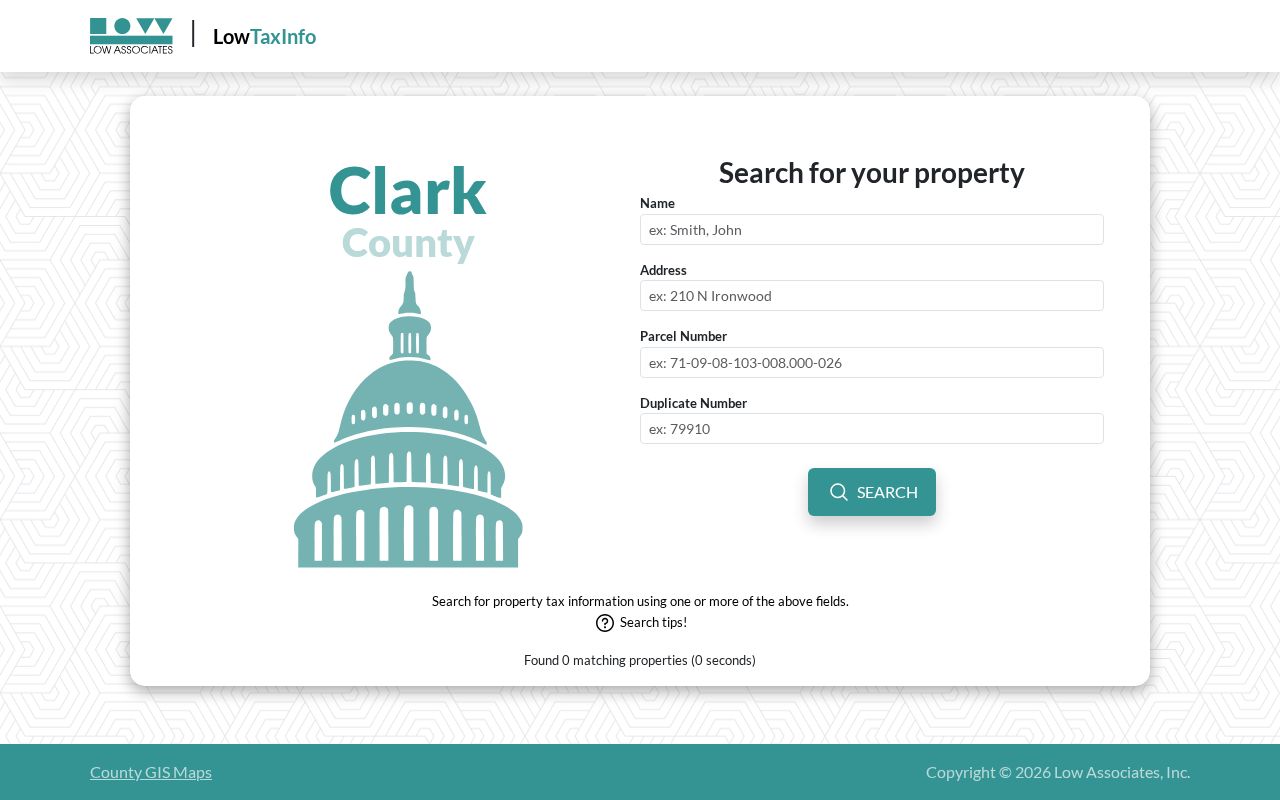
The assessor's parcel page shows the owner label the county publishes. Pick the parcel first. Only then read the owner and assessment fields. The label is the county's, not a guess. But it reflects the tax roll's own timing.
Clark County does not publish a fixed refresh schedule for the owner field. A recent sale may not appear on either screen right away. So weigh the roll's date against the Recorder's newest recorded instrument before trusting either one.
Where Clark County Property Ownership Appears
Clark County never gathers ownership facts on one screen. The assessor, the recorder, and the tax roll each hold a piece, so verifying who owns a parcel means reading more than one source.
| Official source | Ownership clue | Currency and access |
|---|---|---|
| Assessor tax roll | Owner/taxpayer label, mailing address, situs and parcel identifiers | Current tax application; published refresh interval not stated |
| Recorder deed index | Latest deed's grantor, grantee, recording date and instrument reference | Tapestry online indexing begins November 1999; office computers are the fallback |
| Elevate GIS | Mapped parcel connected to assessment information | Current viewer; map boundaries are reference lines |
| INBiz | Indiana business status and registered-agent information | Entity context, not proof that the entity owns a particular parcel |
The source that names a taxpayer is not the source that proves title. In Clark County, the Recorder's index and the recorded deed form the ownership link that counts. For legal reliance, a professional title examination may still be required.
Trace the Owner Label to Clark County's Latest Deed
The Clark County Recorder keeps deeds and other land instruments. Run the roll's owner name through Tapestry, and try reasonable spelling variants too. A solid hit returns the instrument number, recording date, and document type. It also shows grantor, grantee, and a book/page or image link when available. A legal-description clue usually comes with it. Match those details to the subject parcel before drawing conclusions.
The online deed and miscellaneous indexes reach back to November 1999, per the Recorder. That boundary is only online. Clark County ownership records go further. Public-access computers at 300 Corporate Drive, Room 102, open the older material. Staff can route that access, though they will not search the records or give legal opinions.
For copies, fees, and the recorded instrument itself, see Clark County deed records.
Decode Trust, Estate, and LLC Owners in Clark County
A Clark County owner search can surface more than a person's name. You may find a spouse pair. There might be a trust, an estate, an LLC, a fiduciary, or a corporate successor. Copy the punctuation exactly. Keep initials, wording, trustee capacity, and entity suffixes, then try sensible variants of the name. An LLC's registered agent adds context through Indiana MyCase. That listing never replaces the deed. It never tells you who occupies the land.
Probate can interrupt a simple buyer-seller chain, too. Search nonconfidential estate activity in MyCase. Then look for the fiduciary deed or another later instrument at the Clark County Recorder. One caution: a filed estate or foreclosure case does not itself prove that ownership changed. Read the disposition and the recorded transfer. See what actually happened with the property records.
Assessor-label myth. A GIS or tax-roll name is a practical lead, but it does not by itself establish legal title or identify an occupant.
Find an Owner When Clark County's Address Changed
An old address in Clark County can hide the record you need. Rural routes and historic street names appear in older Clark County property records. So do subdivision lots and vanished place names. Jeffersonville's 1802 grid helps, and so does the 1948 absorption of Claysburg. Search both the old and new address forms. Then let the legal description and parcel number settle the question. They show whether two records describe the same land.
The Indiana State Library's Clark County map collection holds Jeffersonville maps from 1837, 1855, and 1868. It also holds an 1875 county owner map and later plat books. A dated plat or owner map can carry an old address across. It bridges that address to a modern parcel. The current deed still settles the question. Treat the map as a bridge, and let the recorded instrument confirm the match.
Note: Record the exact spelling, search fields, portal coverage, and search date so another researcher can reproduce the ownership check.
Use Clark County Property Fraud Alert as a Watch
Property Fraud Alert is a free notification service built on indexed recordings. Once you know who owns a parcel in Clark County, a subscription can flag filings. The filings it flags match a chosen name. It cannot stop a recording, and it will not catch every spelling variation. Nothing it sends is proof of fraud.
Choose name variants with care. Trusts, married couples, and business entities often record under more than one form of a name. Pick them all. If an alert looks wrong, call the Recorder. Ask about the instrument rather than assuming the worst.
A deed in Clark County moves through several hands before it is recorded. The county routes it to Assessor review in Room 104 first. Then it goes to the Auditor in Room 106, and only then to the Recorder. That sequence explains the mismatch in dates. An assessment label, a transfer stamp, and the final instrument can carry different dates. It does not turn the assessment card into the recorded proof of ownership.
When two sources disagree, a short log helps. Track the parcel key, situs, owner label, card date, instrument number, recording date, grantee, and the legal description. Ask the Assessor at 812-285-6225 about the tax roll. Ask the Recorder at 812-285-6235 about the deed index. Neither office settles title questions.
Know What a Clark County Owner Lookup Cannot Prove
A Clark County owner lookup has firm limits. It can tie together an assessment label, a parcel number, and the latest recorded grantee. It cannot prove who lives at the address or who possesses the land today. It cannot reveal unrecorded interests or make a title insurable. Mailing and situs addresses describe different things. Indiana law allows some protected information to be withheld.
When legal title truly matters, pull the underlying documents and bring in qualified legal or title help. That applies to a purchase, an estate, a boundary dispute, or a conveyance. For a routine property search, cite your source and its as-of date. Never present the result as timeless.
Owner name is not proof of title. Ownership may sit in an LLC, trust, or estate, and public information must never be used to stalk, harass, threaten, or harm anyone.