
Decode Clark County Property Tax Records
A parcel account blends records from several offices. The Assessor finds and appraises taxable property, while the Auditor builds the tax duplicates and receives deduction filings. The Treasurer handles collection. For payment, delinquency, or redemption questions, start there, and record the office, year, and source beside every number you save.
| Record field | Meaning | Official source |
|---|---|---|
| Land assessed value | Assessment assigned to the land component | Clark County Assessor / state value data |
| Improvement assessed value | Assessment assigned to taxable improvements | Clark County Assessor |
| Gross or total AV | Combined assessment before applicable deductions | Assessor and tax duplicate |
| Deductions | Approved reductions shown for the account and year | Auditor / parcel record |
| Tax district and bill | District context, amount billed, installments, and year | Auditor and Treasurer |
| Payment or delinquency status | Posted collection status, which may change after payment | Treasurer |
Indiana follows one valuation standard. Under DLGF guidance, property is assessed at 100% of market value-in-use. That figure is not a private appraisal, a listing price, or a deed's recorded consideration, and the tax bill applies deductions and rates to the account rather than reporting any sale.
Look Up a Clark County Property Tax Account
Begin at Low Tax Info. The application accepts several routes. Search by owner name, property address, parcel number or state key, or duplicate number and tax-bill ID. Try a partial address when the suffix or directional wording is uncertain. Copy identifiers exactly. Use the duplicate number to move from the parcel to the correct tax account, and reach the parcel and account application through the Clark County Low Tax entry page.
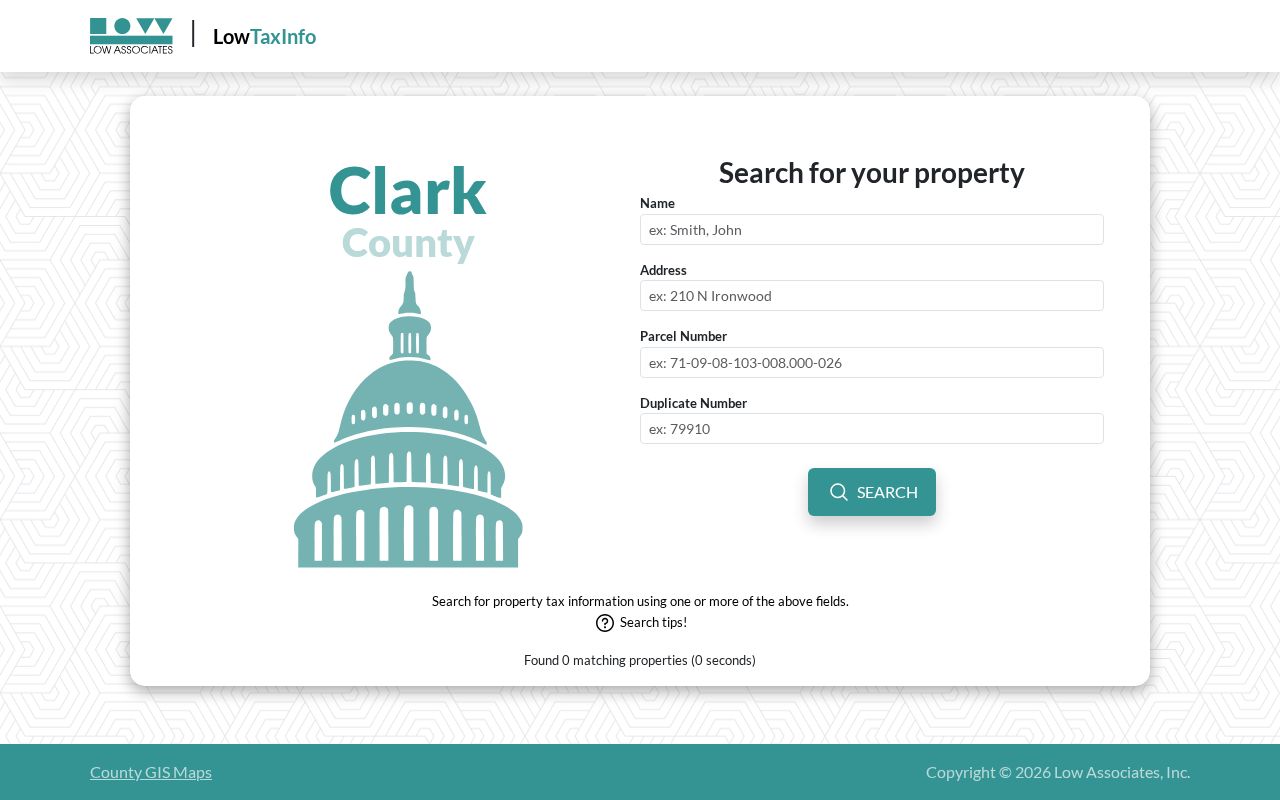
The landing page confirms the search routes. The selected parcel screen then supplies the account-specific year, deductions, values, and tax identifiers needed for a sound comparison.
- Find the parcel by address, owner, parcel/state key, or duplicate number.
- Confirm situs, owner label, property class, and the year attached to each assessed value.
- Open the county's tax lookup and payment route and match the duplicate number.
- Read billed installments and posted status without assuming a just-made payment has already appeared.
- Check deductions separately and contact the Treasurer for current delinquency or redemption figures.
- Assessed value
- The official land and improvement valuation used within Indiana's property-tax system.
- Tax rate or levy
- The applicable rate structure for the parcel's taxing district and year.
- Homestead deduction
- A benefit that generally does not need annual reapplication but must be re-filed after a sale, title change, or eligibility change.
- Tax lien
- A claim associated with unpaid property taxes; delinquency, sale, redemption, and deed are distinct stages.
See Clark County's Online Tax Route
The county's online tax portal handles lookup and payment.
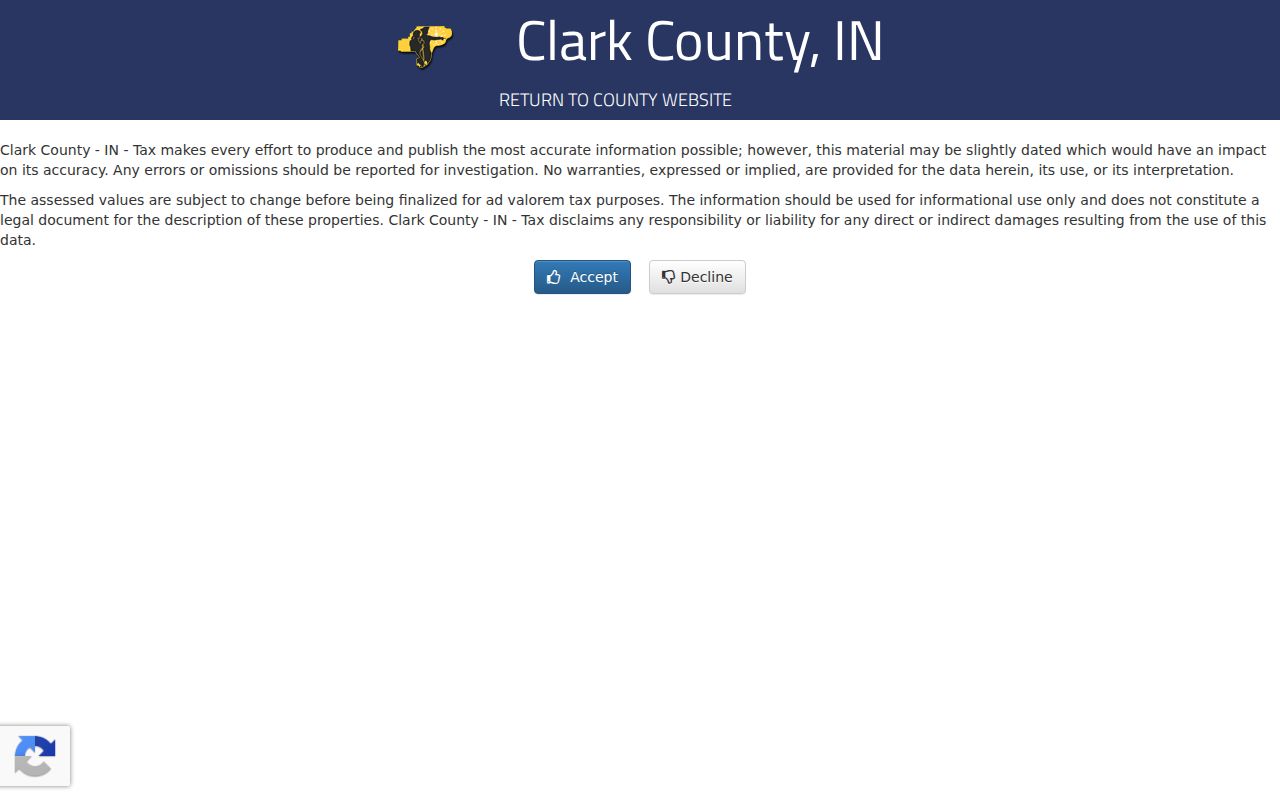
The county's page is a doorway, not proof of a chosen parcel's balance. Confirm time-sensitive payoff or redemption figures with the Treasurer.
Pair the Clark County Assessment Year With Pay Year
A value year pays in the following year, so an assessment year on the account and a later pay year on the bill may describe the same valuation cycle. The labels may not match. Note both years. Calling everything "current taxes" hides the difference. Form 11, the notice of assessment of land and improvements, arrives before the bill.
Annual trending leans on recent sales. Clark County's Assessor describes a prior 14-month sales period. New construction, additions, remodeling, and land-use changes can also move an assessment. A deed can record before the tax roll's owner label refreshes, so compare the recording date with the roll year rather than expecting the new grantee to appear at once.
Cross-Check Clark County Values With DLGF
DLGF's assessed-value search takes partial addresses and names. Results display a combined land-and-improvements total, with Details and Download controls available for a closer look at any parcel.
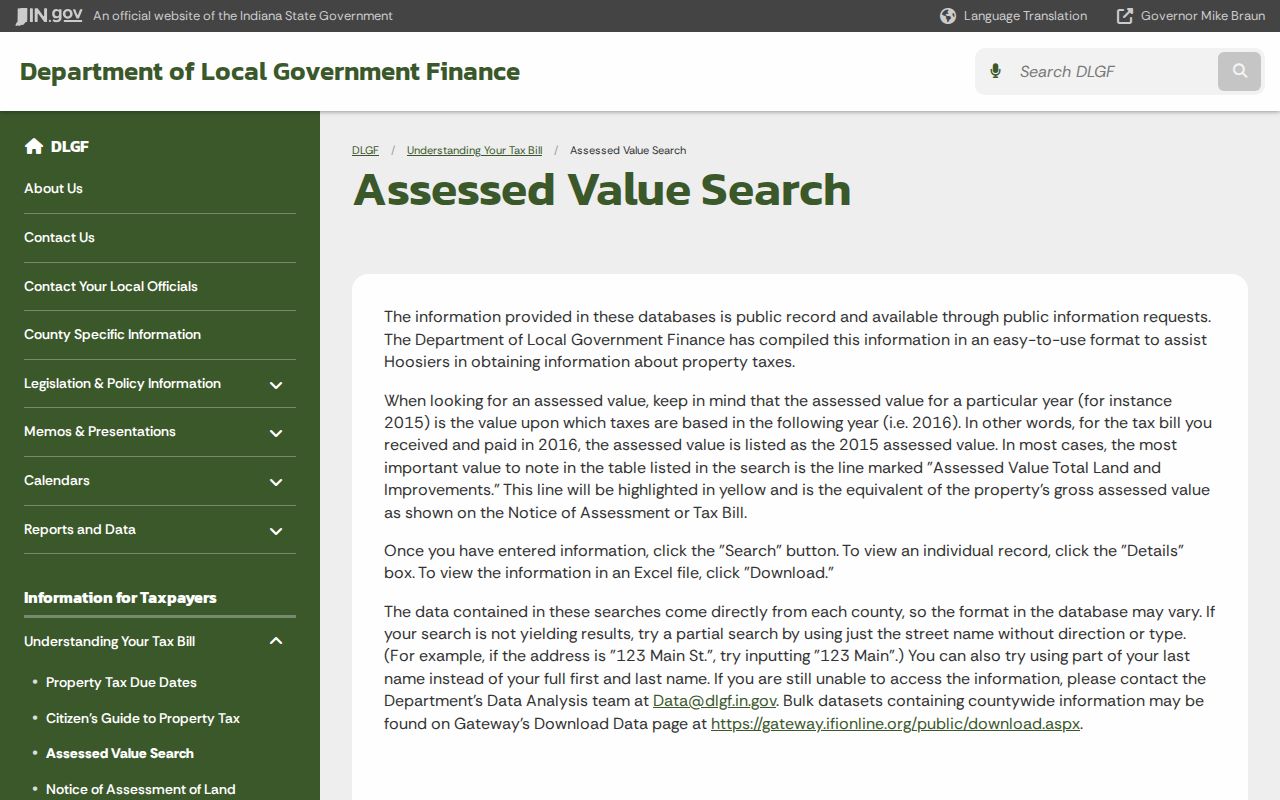
DLGF cautions that counties compile its public data. Treat the state result as an independent, year-labeled cross-check, and resolve any discrepancy with Clark County's parcel record and the local offices.
Clark County's 9.2% AV Change Is Countywide
DLGF's 2026 Exemptions and Deductions Report puts Clark County gross real-property assessed value at $13,480.0 million for 2024. The 2025 figure is $14,722.2 million. That is a 9.2% increase. The number describes the countywide assessment base. It is not a median sale-price change, a city-only trend, or proof that any single parcel rose by that rate.
A DLGF ratio narrative adds context. It notes six formerly vacant sales that were improved, plus new housing starts and commercial trending in Charlestown, Jeffersonville, and Silver Creek townships. Aggregate totals can move for those reasons. An individual appeal still turns on the subject parcel, its record, and comparable evidence, never on the countywide percentage.
Re-file Clark County Deductions After a Title Change
DLGF deduction guidance spans homestead, mortgage, Over-65, blind or disabled, disabled-veteran, rehabilitated-property, heritage-barn, and other credits. Most benefits renew without yearly paperwork. A sale, title change, or eligibility change is different. The Clark County Auditor warns that deductions must be re-filed after a deed or title change, or the benefit may be lost.
A county homestead filing asks for the final five Social Security digits of each resident, or the final five driver-license digits when no SSN exists. Over-65 applicants should bring the last federal filing. Use current forms. Share sensitive details only through the Auditor's official procedure. Verify unexpected homestead-audit letters with the office first.
Keep the deduction filing apart from the deed and the assessment appeal. A recorded title change can force a re-file even when the property use stays the same. The Auditor's homestead-audit partner is Tax Management Associates. So county letterhead alone proves nothing either way. Confirm the sender and the requested channel with the Auditor before disclosing identifiers.
Separate Clark County Payment Fees From Tax Due
Clark County charges service fees when you pay a tax bill online. Card payments carry a charge of 2.25% plus $1.50. An e-check costs $1.50 for transactions up to $99,999. None of that money is property tax, penalty, or interest. It goes to the payment processor. Check the current screen before you submit, since fee schedules can change.
Need a duplicate tax bill? Want to confirm a payment that just posted, or get an exact balance? Call the Clark County Treasurer at 812-285-6205. Keep your confirmation number and the posting date. A portal status seen before a payment posts does not prove delinquency, so don't treat it as the final word.
Claim a Clark County Tax Overpayment on Time
Overpayments get a list, not an automatic refund. After each installment, the Clark County Treasurer publishes an overpayment list and mails notice to the taxpayer's address on file. Claiming the money takes the county form plus proof of payment. The Auditor cites a hard cutoff. Under IC 6-1.1-26-6a/c, an unclaimed amount can pass to the county general fund after three years.
Don't assume a credit rolls forward. Check the current list and its instructions instead. When asking the Treasurer to reconcile an amount, use the parcel's duplicate number, payment date, payer name, receipt, and installment. The mailing address on the tax account may differ from the situs, so it proves nothing about occupancy. Get the office response in writing. Note whether the outcome is a refund claim, a corrected posting, or a balance still due.
Distinguish Clark County Delinquency From Tax Sale
Delinquency and sale are separate stages. By July 1, the Treasurer certifies the delinquent-property list following the Auditor's process. Delinquent taxes over $25 can get a property listed. Removal requires taxes, special assessments, penalties, interest, and costs. Current sale material routes through SRI Services, where redemption figures recalculate daily and payment instructions call for cash or cashier's check.
A delinquent-list entry, tax-sale certificate, redemption, tax deed, and later quiet-title case are distinct events, so a listed parcel has not transferred. For court activity, search Indiana MyCase. Read the chronological summary and disposition rather than trusting the case caption.
Appeal a Clark County Assessment With Form 130
Start with Form 11 and the parcel record. The DLGF appeal guidance lays out the route: Form 130, an informal conference, the assessor's recommendation, PTABOA, and then the Indiana Board of Tax Review. June 15 is a common deadline where it applies. The citizen guide names that date, but the current Form 130 and Clark County's own filing deadline control.
Good evidence is parcel-specific. Bring the property record card, photographs, measurements, condition, use, relevant sales, an appraisal if available, and corrections of factual errors. PTABOA hearings in Clark County fall on the second Tuesday of each month at 1:30 p.m. in Room 418. Call the Assessor at 812-285-6225 to confirm. The ratio study divides assessed value by sale price. One transfer is not a controlling comparable. Ask whether the sale was vacant, improved later, or outside the relevant neighborhood and property class. DLGF's county and township trends add context. The subject record and well-matched evidence still carry the parcel-level argument.
Protect the appeal window. Do not rely on an old summary date. Read the current notice and Form 130, confirm the Clark County deadline with the Assessor, and keep proof of timely filing.
The state appeal page is the current route to forms and process guidance.
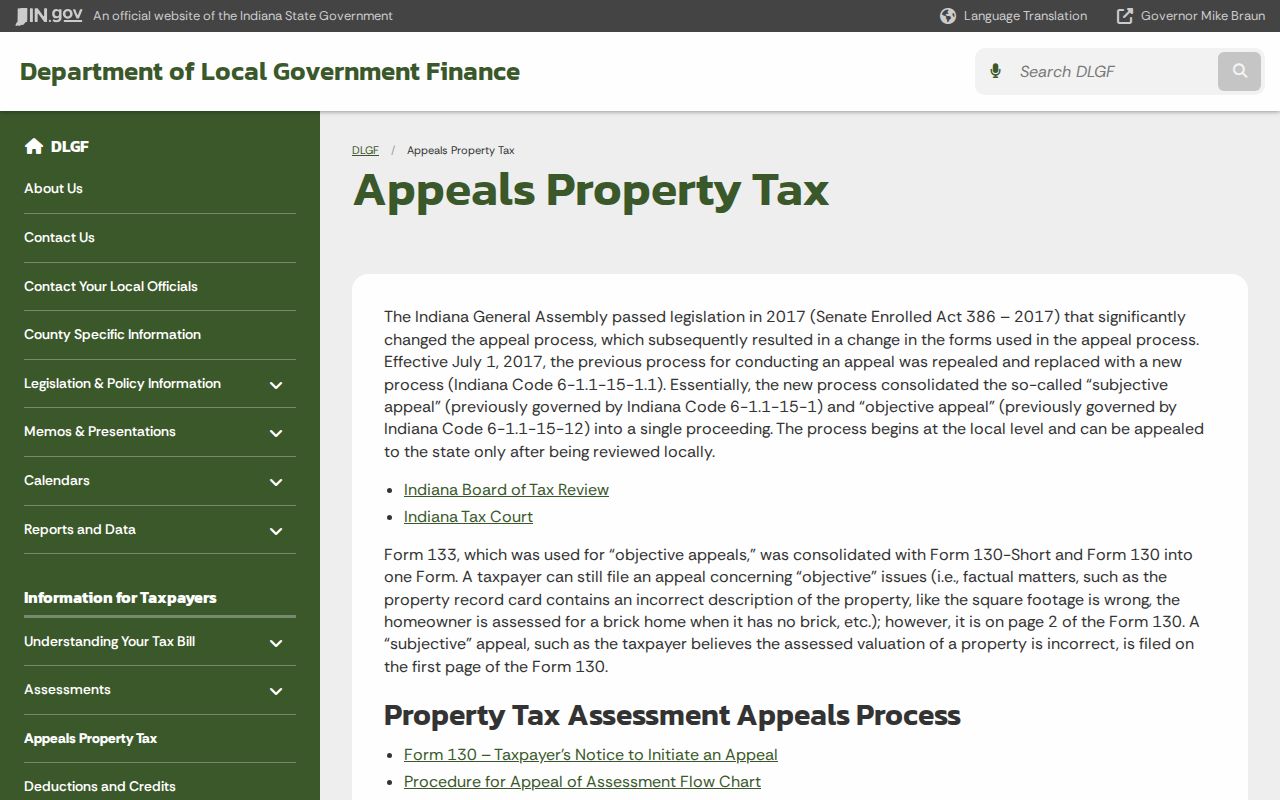
The statewide appeal resource gives the general path. For controlling dates and local filing details on any Clark County parcel, rely on the county notice and direct confirmation from the office.