
Separate Three Clark County Property Value Measures
Indiana assesses real property at 100 percent of market value-in-use. That is a statutory concept, administered through county records and state oversight. That standard does not make every public number a sale estimate. Three figures travel under the value label. Keep the assessed amount, the recorded transaction price, and any market opinion in separate columns. Compare them only after that.
| Value Type | What It Means | Where It Is Recorded |
|---|---|---|
| Assessed value | Mass-appraisal figure used in Indiana's tax system, with land and improvements often separated | Clark County roll, Low Tax Info, and DLGF data |
| Market value-in-use | Indiana's standard for the property's utility to its owner or a similar user | Assessment method and DLGF guidance |
| Last sale or consideration | A past transfer amount that may not be an open-market price | Deed, sales disclosure, or sale-history field when shown |
| Private market opinion | A dated opinion based on condition, purpose, and market evidence | Licensed appraisal, not the county roll |
The Department of Local Government Finance compares assessed value to sale price in ratio-study work. That study checks assessment quality countywide. Timing, condition, and sale validity all differ, so it never estimates one parcel.
Indiana Defines Clark County Assessed Value
The DLGF assessment overview explains the 100 percent market-value-in-use standard and the ratio-study process. Clark County's Assessor locates, identifies, and appraises taxable property under that framework. Trending happens every year. Sales from the prior 14-month period feed the updated estimates. Mass appraisal groups evidence across classes and neighborhoods. That supports consistent administration rather than a room-by-room inspection or a prediction of one closing price. A record can change without any sale. New construction, a class change, a parcel split, or new trend evidence can trigger it.
- Assessed value
- The public valuation used in Indiana's property-tax system.
- Market value-in-use
- The state's assessment standard, not a private listing estimate.
- Assessment ratio
- Assessed value divided by sale price for ratio-study analysis.
- Trending
- The annual process that updates assessments using market evidence.
Look Up a Clark County Assessed Value
An exact address or parcel key works best, and every result should stay attached to its year. The county's Low Tax Info routing supports searches by owner name, address, parcel number, and duplicate number. Field rules vary. Follow the labels the screen currently displays.
- Search Low Tax Info by situs address, then copy the state key and duplicate number.
- Record land, improvement, and gross or total assessed value only when displayed.
- Save the value year, pay year, property class, and update label shown.
- Cross-check the public value in the DLGF assessed-value search.
- Review a deed or sales disclosure separately if a past transfer amount matters.
- Land value
- The assessment assigned to the land component.
- Improvement value
- The assessment assigned to buildings and taxable improvements.
- Gross assessed value
- The total before deductions shown elsewhere in the tax process.
Note: DLGF says a value year pays in the following year, so the largest number on a screen may not match the bill year. Check the year label first.
Cross-Check Clark County Property Value With DLGF
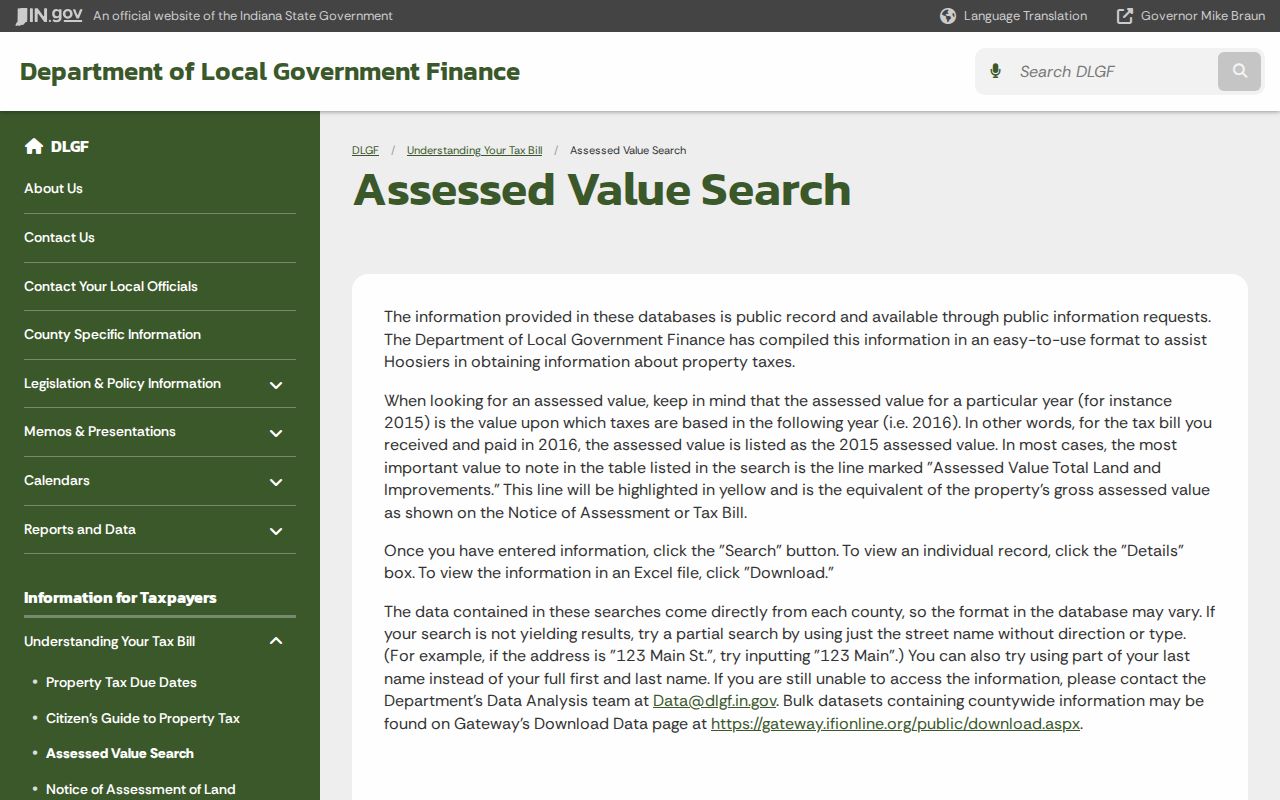
The DLGF assessed-value search accepts partial address or name queries. Results identify “Assessed Value Total Land and Improvements.” Details and Download controls sit alongside the results. State data come from county submissions. That makes the DLGF tool a strong second source for any Clark County property value check. It is not a replacement for the Assessor.
State and county records sometimes disagree. When they do, preserve both dates and identifiers, then ask the Clark County Assessor which roll is current. Never average the numbers or quietly pick the higher one.
Clark County Gross Assessed Value Rose 9.2 Percent
The 2026 DLGF Exemptions and Deductions Report lists countywide gross real-property assessed value of $13,480.0 million for 2024 and $14,722.2 million for 2025. That is a 9.2 percent increase. Strong as it looks, the figure covers the whole county.
| Report year | Gross real-property AV | What it does not show |
|---|---|---|
| 2024 | $13,480.0 million | A median sale price or one parcel's change |
| 2025 | $14,722.2 million | A city-only or neighborhood-only trend |
| Change | 9.2 percent | What any home would sell for |
Countywide growth blends trending, new construction, classification changes, and shifts in the taxable base. The total has scale. It is not a rate for one parcel. No blanket percentage estimates an individual Clark County property value. Test a single parcel by comparing its land, improvement, gross, and year fields. Compare them across dated records. Then hunt for a class change, a new improvement, a split, or a combination. Or check for a corrected account before crediting general market movement.
Recorded Sales Add a Different Clark County Value
A past sale proves a transfer happened on a date. It does not prove today's market value. Indiana's sales-disclosure information covers public disclosures made after July 1, 2008. Phone numbers inside disclosures stay restricted. The statute is IC 6-1.1-5.5-3(d). A disclosure amount can differ from deed consideration. It can also differ from the value selected for assessment analysis. Check whether the sale was arm's length. Check whether real and personal property were bundled, and whether the parcel changed afterward. Family transfers, estate instruments, quitclaim deeds, and multi-parcel deals rarely work as direct price comparisons.
| Sale-record clue | Question to ask |
|---|---|
| Transfer date | How far is it from the value year? |
| Parcel count | Did the amount cover more than one tract? |
| Document type | Was this an ordinary sale or another form of transfer? |
| Later improvements | Did the property materially change after closing? |
Clark County Ratio Studies Describe Trends, Not Appraisals
The 2025 Clark ratio narrative flags six vacant sales that were improved after the sale. It also notes new housing starts and commercial trending in Charlestown, Jeffersonville, and Silver Creek townships. It lists neighborhood codes too. Codes need GIS confirmation. Never assign one to a city or parcel on your own.
The report explains why analysts screen sales and group evidence, since a vacant sale improved later is not automatically comparable to an already improved parcel. Treat the study as county review. It is no calculator for one property.
Neighborhood codes are not place names. They are administrative grouping clues. Match a code to the parcel through current county data before citing it. Retain the ratio narrative's date, and do not describe commercial trending in a township as a residential price movement.
Note: A ratio is assessed value divided by sale price in study work, not a private appraisal or an online home estimate.
Deductions Do Not Redefine Clark County Property Value
Deductions shrink the taxable amount, not the value itself. A homestead deduction, for instance, trims a tax bill. It leaves the gross assessed value and the recorded sale price untouched. Keep those numbers in separate fields. Taxes, net taxable value, deductions, and gross assessment each answer a different question. A title change can also affect who qualifies for a benefit.
The DLGF deductions and credits page covers the state programs. The County Auditor handles local deduction and tax-duplicate work. Questions about bills, deductions, or a Form 11 appeal fit better on the Clark County property tax records page. The valuation task here ends at naming what each number means.
Start any comparison with gross assessed value. Deductions and credits deserve attention only after the value type and year line up. Otherwise a lower Clark County tax bill gets mistaken for proof of lower market value.
Know the Limits of Clark County Property Value Records
No roll value captures every current condition. A private repair, a market shift, an easement worry, or a special transaction term can all escape the number the county recorded. A roll value does not establish title either. When reading Clark County property records, the date and purpose of a figure matter as much as the amount.
Value is not price. A Clark County assessed value supports taxation and is not what the property is guaranteed to sell for. It is not a licensed appraisal.
For a sale decision, seek current market evidence and qualified advice. For a public-record comparison, cite the parcel, the source, the value type, and the year so another reader can reproduce the result.